"A Reliable Bible". we tend to have the perception that the Bible's that are around
are not reliable ,we think because they are so old that they can not be accurate anymore because of the Translations. How ever this assumption is not really accurate,
because since the Bible is the Foundation of Western Civilisation, there where
no effort spared in investigating this book, there is surely no other Book
in this world, that is so well studied as the Bible, specially in the last 100 years
it has been scrutinised.
Many think the Bible is false because its written in English , Dutch, or German.
and that the Original has been lost, or was written Century's latter.
Sure it has been translated and sure if one would want to know precisely
what the Original text has said then one would need to learn Greek,
(just like if you want to know exactly how Rumi wrought his poetry you would need to learn Farcy--- how ever you don't need to learn Farcy to appreciate his genius, only
if you want to study it in deepest sense)
And that's why All Theologian's and Priest have to learn Greek in order to study
the Original text of the Evangelium deeper.
Some people ask why Greek, thay say that Jesus spoke Aramaic and not Greek
so the Gospel should be in Aramaic. But just like i am writing this Blog
in English, so the Gospel was written in Greek ,because everyone in this region of the world knew Greek, just as we now know English.It was a Hellenistic ( Greek Culture)that dominated then just like now the English speaking culture dominates.
The Letters that in the Early Church circulated where all written in Greek so that all could understand,
in the same way as when you or i wright a forward massage to all of our friends
we wright it in English, So Greek is the Original Language of the Gospel or the New Testament -- the Evangelium.
The Bible, the Gospel and the Evangelium we say is meaning is the same, while Bible means " The Book " Gospel and Evangelium means "The Good News"
Evangelium which means good news which we can find in the Holly Bible.
The Evangelium consists of Letters that where written by the Disciples of Christ
in the First Century , so the First Generation of Christians, this letters
where Circulated in the Early church and read aloud in front of the Congregation.
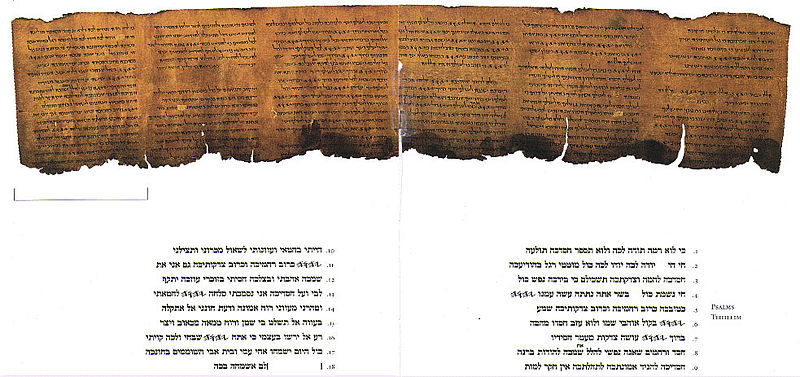
These Qumran scrolls are generally dated at the same time as Christ Lived
and are confirming the accuracy of the Bibel.
(Click on Image to view details)
The cave at Qumran where the scrolls where found:

Catherine's Monastery ,Sinai

Below : A picture of the Codex Sinaiticus found in Saint Catherine Monastery.

As an comparison, the first Fragment of a
text's from the teaching of the Buddha,
the Lotus sutra can be found only
500 to 600 Years after Buddha,
text's from the teaching of the Buddha,
the Lotus sutra can be found only
500 to 600 Years after Buddha,

this is the earliest Buddhist text we can find.
http://www.buddhanet.net/e-
http://www.buddhanet.net/e-
Both the Old and New Testaments are strongly supported by manuscript evidence (the evidence of early hand written copies). The famous Dead Sea Scrolls are one example of the Old Testament evidence. These documents came from the “library” of a settlement founded at Qumran before 150 B.C. and abandoned about 68 A.D. Some of the manuscript copies were made during that period, and some were written earlier (third century BC) and brought to the settlement. Ignoring spelling-oriented (orthographic) changes and similar small differences, the Dead Sea Scrolls match the Hebrew text behind today’s Old Testament, in spite of the passage of over 2,000 years (where one would expect errors to creep in).
Over 20,000 known manuscripts document the New Testament text. This makes the New Testament the most reliable document of antiquity (a document written before the printing press). These manuscripts vary in size from a part of a page to an entire Bible (Old and New Testaments). The earliest New Testament manuscripts date from the second century (100-199) AD These manuscript copies were written in different languages by people of different nationalities, cultures, and backgrounds. In spite of all those differences between them, the New Testament texts all agree. (That is, those differences that we do observe between these hand written documents are occasional changes in the spelling of names or isolated cases of missing or changed words. Still, since we have so many copies, it is obvious to anyone but the hardened skeptic can that they all represent the same text.)

also known as p52
. is a fragment of the Gospel of John
that dates from around AD 135.

 There are thousands of partial and complete handwritten
manuscript copies of the Old and New Testament.
These manuscripts are on display today in places like the Smithsonian Institute,
the Cambridge University Library, the British Library, etc.
These manuscripts have allowed scholars to verify that the Bible
we have today is the same Bible the early church possessed
2,000 years ago.

Tests to see if the Bibel is an accurate Translation
there are many ways to see if the Bible is accurate. One of this tests
have been made by the Germans scholars they have gone true all available ancients
Texts from the first 3 hundred years...they have found Thousands
of early quotes from the Bible,because everyone quoted the bibel
at that time ,Church Fathers ,Historians, opponents of the Church everyone quoted the Bible.
So what they did ,they have copied all reverences
that this texts made to the Bible on a paper, then tehy have
checked this text's written in the first 3 hundreds years with the
Greek text that we use today to translate from .
and they have found that this early text's mach the text's that we use
now to a remarkable high degree , in fact they found the only dissimilarity's
where minore mistakes like a coma forgotten or a grammar mistake.
So even if the First COMPLETE assembled BIBLE has been found
from the year 300 after Christ,the First individual Text's where much ealryer
nameli 20 A.D Because the First time ( 300 A.D ) this text's
where put together and the disciples have identified what all Christians
should and must read to understand the Massage our Lord has brought.*
non the less by looking at the quotes that are around in the First 300 years we can Guaranty that the text's where around before and not only around but that they are exactly as they are today
in the Greek text's we use to translate from.
This argument is so strong, that, if we deny the authenticity of the New Testament we may with a thousand times greater propriety reject all the other writings in the world.
source http://www.christianity.co.nz/bible-3.htm
find more Information here:
http://www.everystudent.com/features/bible.html

So the Bibles you find today are the same
there are minore differences of course you will find Bibles that try to translate
the Greek text, into a modern Street English but the meaning of the text stays the
same even though stile may be different.
Even if you take a Bible from the Jehovah's Witness it still can be used for reading because also them they didn't manage to change it so dramatically because the old text's are still with us .
The differences in the Bible's that are around today. are differences
that Theologians can see and make some differences in the Theological
apologies that result from interpreting this text's . But on a day to
Day level there are literally very very minimal differences.The essence is the same in
all available Bible. The standard Bible that is being used today is the
"King James Bible" but there are also Catholic Bibles etc, but they are all
more or less the same.
How ever the Interpretation of the Bible, Now that's a different Mather
this differs widely but this we will leave for a other Blog.
Talking about the Qumran Text's it should be said that
Ancient Books Discovered In The Holy Land Close To Where Dead Sea Scrolls Were Found…

Discovery: The impression on this booklet cover shows what could be the earliest image of Christ
Astonishingly, one of the booklets appears to bear the words ‘Saviour of Israel’ – one of the few phrases so far translated.
The director of Jordan’s Department of Antiquities, Ziad al-Saad, has few doubts
these booklets are genuine and artefacts of the early Christian church.
He believes they may indeed have been made by followers of Jesus in the few decades immediately following his crucifixion.
He believes they may indeed have been made by followers of Jesus in the few decades immediately following his crucifixion.
‘They will really match, and perhaps be more significant than, the Dead Sea Scrolls,’ he says. ‘The initial information is very encouraging and it seems that we are looking at a very important and significant discovery – maybe the most important discovery in the history of archaeology.’
If he is right, then we really may be gazing at the face of Jesus Christ.
Read more: http://www.dailymail.co.uk/news/article-1372741/Hidden-cave-First-portrait-Jesus-1-70-ancient-books.html#ixzz1VSjzozz4


